
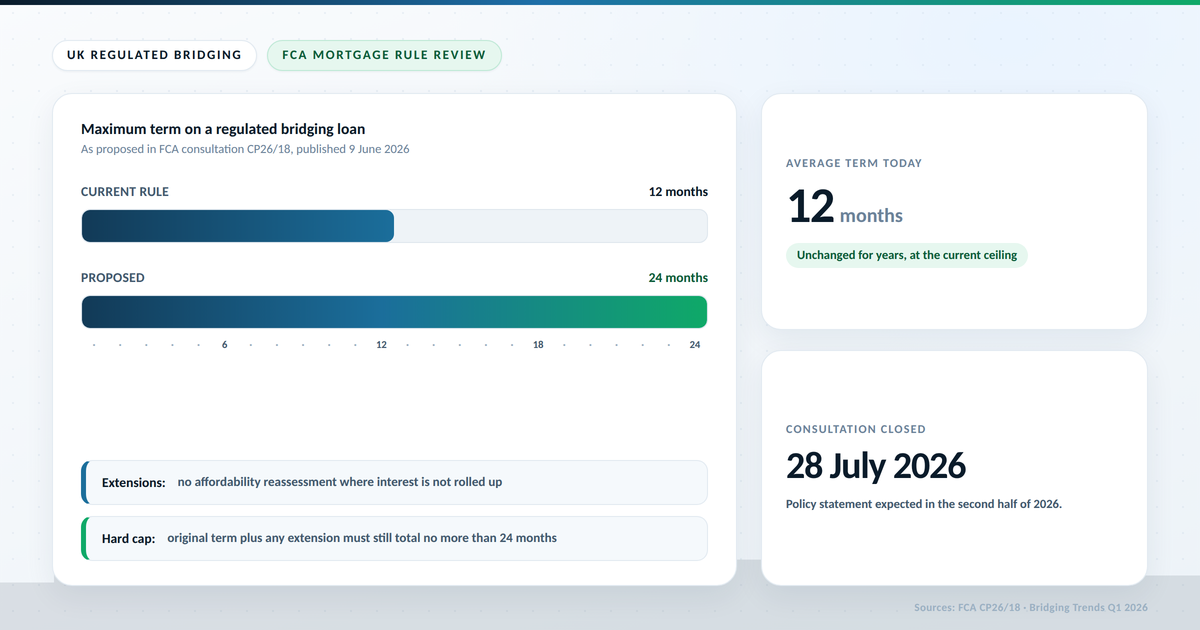
The FCA is proposing to double the maximum term on a regulated bridging loan, from 12 months to 24. The consultation closed on 28 July. The policy statement is expected before the end of the year.
CP26/18, published on 9 June 2026, is the Mortgage Rule Review moving from discussion into drafting. It covers six areas: interest-only and part-and-part, retirement interest-only, variable and irregular income, foreign currency loans, credit-impaired borrowers, and bridging finance.
For short-term lenders, three proposals matter:
- The maximum term on a regulated bridging loan rises from 12 months to 24.
- The original term plus any extension is capped at 24 months in total, so the headroom cannot be used twice.
- The requirement to reassess affordability is removed for extensions that do not roll up interest.
Now put that next to the market. Bridging Trends reported an average term of 12 months in Q1 2026, unchanged quarter after quarter. That is not what borrowers independently chose. It is the regulatory ceiling showing up in the data. When a ceiling moves, the distribution underneath it moves with it.
This is a product change wearing the clothes of a rule change, and most loan books are not configured for it.
Worth saying plainly: these are proposals, not rules. Nothing below is settled until the policy statement. But the lenders who will convert this into business in 2027 are the ones treating the second half of 2026 as preparation time rather than waiting time. Here is what that preparation actually involves.
1. A 24-month bridge is a new product, not a longer field
The instinct will be to change a maximum value in the product configuration and call it done. That is how lenders end up with a 24-month loan priced, underwritten and monitored as though it were a 12-month one.
What actually has to change
A second year of exposure on a short-term facility is a different credit proposition. Pricing has to reflect a longer period of illiquidity and a wider band of outcomes. Your funding lines need to accommodate the tenor. Your investor reporting needs to show a term profile that is no longer bunched at 12 months. And your credit policy needs a documented view on which cases justify the longer term, rather than defaulting to the maximum because it is available.
The result: The lenders who treat this as a configuration change will write 24-month loans at 12-month pricing, and find out what that costs in 2028.
2. Retained interest over 24 months changes the day-one advance
This is the part that bites first, and it is pure arithmetic rather than judgement.
What actually has to change
On a retained-interest facility, doubling the term roughly doubles the interest held back, which reduces the net advance the borrower receives at the same gross loan to value. On a rolled-up facility, it roughly doubles the erosion of equity by redemption, which means the exit has to carry more. Your system has to model both to the new limit and show the borrower the day-one and day-730 positions side by side, not just the headline rate.
For context on how quickly that compounds: the average monthly bridging rate was 0.82% in Q1 2026. Over 12 months that is a meaningful slice of the advance. Over 24, it is a different conversation about whether the deal works at all.
The result: Longer terms are not automatically better for the borrower, and a system that cannot show that clearly will let unsuitable cases through.
3. Extensions stop being an exception and become a path
Today, an extension on a regulated bridge is handled as a one-off, usually manually, often by whoever knows the case best. Removing the affordability reassessment for extensions that do not roll up interest turns that into something you will do routinely and at volume.
What actually has to change
- A defined extension workflow with its own approval rules, documentation and customer communications
- A system that knows which extensions qualify for the lighter treatment and which do not, rather than relying on an underwriter to remember the distinction
- An audit trail showing why each extension was granted, because a routine process is exactly what a supervisor will sample
- Reporting on extension rates by product, introducer and vintage, because a rising extension rate is your earliest signal that exits are failing
The result: Convenience for the borrower and a new operational risk for you, arriving in the same rule change.
4. The combined 24-month cap has to be enforced by the system
The proposed cap is on the total. An 18-month original term leaves six months of extension, not twelve. Get that wrong and you have written a loan outside the permitted term, which is not a commercial error but a regulatory one.
What actually has to change
Remaining permitted term becomes a calculated field on every regulated case, visible at origination and at every extension decision. The system blocks an extension that would breach the cap rather than warning about it. Re-bridges and refinances of your own loans need the same scrutiny, since a fresh facility replacing an expiring one is where a term limit is most easily circumvented by accident.
The result: A rule that is impossible to breach beats a rule that everyone has been trained on.
5. Permissive rules move the burden of proof onto you
The CP26/18 proposals are largely permissive. They allow firms to lend where the rules previously restricted them. They do not require anyone to do anything. That distinction matters more than it first appears.
What actually has to change
When the rulebook stops making the decision, Consumer Duty makes it instead. You will need governance showing why your longer-term policy is appropriate, evidence that customers understood what they were taking on, and outcomes monitoring that would surface harm if your 24-month lending performs worse than your 12-month lending. The same logic applies to the credit-impaired clarification in the consultation, where the FCA notes that some firms have been using the glossary definition as a blanket decline rather than as the narrow provision it is.
The result: Freedom to lend is granted at the level of the rulebook and earned at the level of your evidence.
6. Exit monitoring has to stretch to match the term
A 12-month bridge is underwritten against an exit you can see. A 24-month bridge is underwritten against an exit two years out, through a rate cycle, a valuation cycle and possibly a change of borrower circumstances.
What actually has to change
Exit viability stops being an origination test and becomes a monitored position. Re-test the stated exit at defined intervals rather than at redemption. Track refinance exits against current term-lender criteria rather than the criteria that applied when you wrote the loan. Flag sale exits where local evidence no longer supports the assumed value or the assumed sale time. On a longer book, the loan that quietly stops working is more dangerous than the one that fails loudly.
The result: You find out about a failing exit in month 14, when there is still time to do something about it.
7. Be configured before the policy statement, not after it
The policy statement is expected in the second half of 2026. That is the moment your competitors announce 24-month regulated products. If your response at that point is to open a development ticket, you will spend the quarter watching cases go elsewhere.
What good looks like
A modern loan management system makes term limits, extension rules, interest calculations and disclosure templates configurable rather than hard-coded. The proposals are public now. The work of building the product, the calculations and the monitoring can be done now and switched on when the rules land.
The result: Regulatory change becomes a release note rather than a project.
Why this matters now
The timing is awkward in a useful way. The wider bridging market has cooled: BDLA members completed £1.8bn in Q1 2026 against £2.5bn in Q4 2025, with applications down from £11.7bn to £9.9bn and loan books at £11.5bn. Bridging Trends also recorded unregulated lending at 59% of the market in Q1, the highest share since the end of 2021.
So the regulated segment is being handed a materially better product just as lenders are looking for somewhere to grow. That is not a coincidence in the FCA’s thinking, and it should not be one in yours.
Three things separate the lenders who will be ready from the ones who will not:
- A product built for a 24-month term rather than a 12-month term with the limit raised
- An extension process designed for volume, with the combined cap enforced automatically
- Consumer Duty evidence generated by the workflow rather than assembled for a review
Neaxaco’s loan management platform is built so that rule changes of this kind are configuration rather than development.
- Configurable term limits and extension rules, including hard caps the system enforces
- Interest modelling for retained and rolled-up structures across any permitted term
- Extension workflows with their own approvals, documentation and reporting
- Consumer Duty evidence and outcomes data produced as a by-product of the work
Ready before the policy statement lands?
See the platform in action. Book a personalised demo and we will walk through your regulated book, so you can:
- Model 24-month products before the rules are final
- Turn extensions into a controlled, reportable process
- Evidence Consumer Duty outcomes without a manual review cycle
Talk to Neaxaco about how our lending software can turn your business vision into reality. Email info@neaxaco.com
Sources
- FCA CP26/18, Mortgage Rule Review: supporting first-time buyers and underserved consumers, published 9 June 2026, consultation closed 28 July 2026, policy statement expected in the second half of 2026. Proposals cover interest-only and part-and-part, retirement interest-only, variable and irregular income, foreign currency loans, credit-impaired borrowers and bridging finance. The bridging proposals extend the maximum regulated term from 12 to 24 months, cap the original term plus any extension at 24 months in total, and remove the affordability reassessment requirement for extensions that do not roll up interest.
- FCA Mortgage Rule Review, earlier stages: DP25/2, feedback statement FS25/6 and policy statement PS25/11.
- Bridging Trends, Q1 2026 (published 14 May 2026): average term 12 months; average completion time 53 days; average monthly rate 0.82%; average LTV 52%; contributor lending £199.2m; unregulated lending 59%, the highest share since the end of 2021; first charge 91%.
- Bridging Trends, 2025 annual data: average completion time 43 days, the lowest since 2017, down from 47 days in 2024.
- Bridging & Development Lenders Association (BDLA), Q1 2026 quarterly data (published 12 June 2026): completions £1.8bn against £2.5bn in Q4 2025; applications £9.9bn against £11.7bn; total loan books £11.5bn.
Note: CP26/18 is a consultation. The proposals described here are not rules and may change before the policy statement. Firms should read the consultation text itself rather than relying on any summary, including this one. Bridging Trends figures reflect lending transacted by its contributor panel of specialist packagers and are an index of market behaviour rather than total market size. This article is general commentary and is not legal, regulatory or compliance advice.